






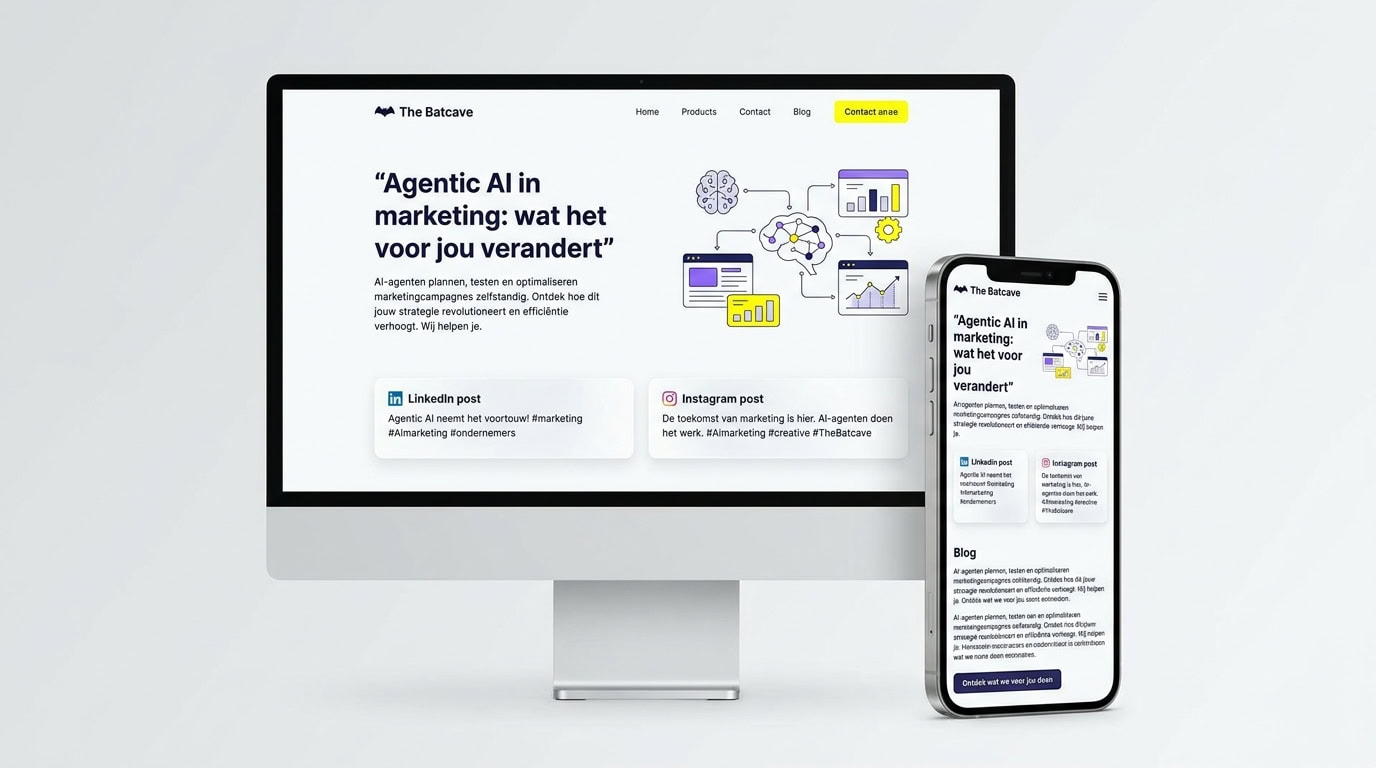
AI agents now book your ads, write your campaigns and optimise your budget. And they do it without a human still looking at it.
What long sounded futuristic is simply reality in 2026. Hershey uses agentic AI to steer 2 billion dollars of marketing budget in real time. Dentsu builds complete campaign workflows that largely run without human intervention. And processes that used to take three days are now handled in less than ten minutes. As an entrepreneur or marketer you cannot ignore this.
What exactly is agentic AI?
Agentic AI is the next step after generative AI. Where tools like ChatGPT or Midjourney respond to what you input, AI agents act independently. They plan, execute and optimise. They can monitor your competitors, segment audiences, test ad copy and shift budgets. All without you approving every step. Large marketing agencies call it a shift from a “relay between specialised teams” to a control centre with autonomous systems.
91% of marketers actively use AI in their work today. A year ago that was still 63%.
The big platforms are done testing
Canva recently acquired Simtheory and Ortto: an AI platform for collaboration and a tool for customer data and marketing automation. Google introduced AI Brief within AI Max, where marketers write a short brief and the AI translates it into campaign execution. Adobe launched CX Enterprise, a system in which AI agents autonomously carry out tasks based on business goals, from audience segmentation to creative output.
Three different companies, three different approaches. But the core is the same: AI will do the executional work, humans guard the strategy and the brand identity.
The brands that stay strong in 2026 use AI for speed and structure, but keep humans in charge of the story.
What does this mean for your brand?
For small and medium-sized businesses this cuts both ways. On one hand you gain access to automation that used to be reserved for multinationals. On the other hand, the bar for what counts as “good enough” rises. If your competitors launch campaigns that are continuously optimised by AI, and you still work with a monthly report and gut feeling, you fall behind.
There is also a pitfall: if everyone uses the same AI-driven tools, differentiation at the execution level disappears. What counts then is your brand identity. An AI agent can write an ad. But that ad needs your tone, your positioning, your visual language. That is the part you do not simply automate.
Another element you cannot ignore: the search bar is fundamentally changing. Consumers no longer search, they ask questions to AI assistants. That assistant picks a supplier, not a list of options. Visibility in that system requires clear, structured content and a brand system that scales. That is exactly where strategic marketing makes the difference.
What you can already do now
Invest in what an AI does not have: a clear brand. Make sure your brand voice is documented. Make sure your visual identity is consistent. Make sure you know what you want to convey, not just how. Because once the tools take over execution, you are the one writing the brief. And a bad brief delivers bad output, even with the best AI.
Human stays the strongest signal
Ironically, the rise of AI brings a growing demand for humanity. 73% of consumers say they recognise AI-generated content and consider it less credible. Brands that invest in real stories, real images and authentic communication win trust. Not because it is cheap, but because it works.
Look too at the rise of creator content: advertisers are investing 18% more in creators this year than last. Not for the reach, but for the community behind it. AI can scale, but it cannot build trust. That is still human work. See how we approach that in our portfolio and see what makes the difference.
Conclusion
Agentic AI changes the rules of marketing faster than most entrepreneurs realise. The question is not whether you will get started with it, but whether your brand stands strong enough to make that technology work for you. Anyone who invests now in a strong brand system, structured content and scalable communication lays the foundation for a marketing machine that works both human and automated. Want to know what that looks like for your business? See what we can do for you.