






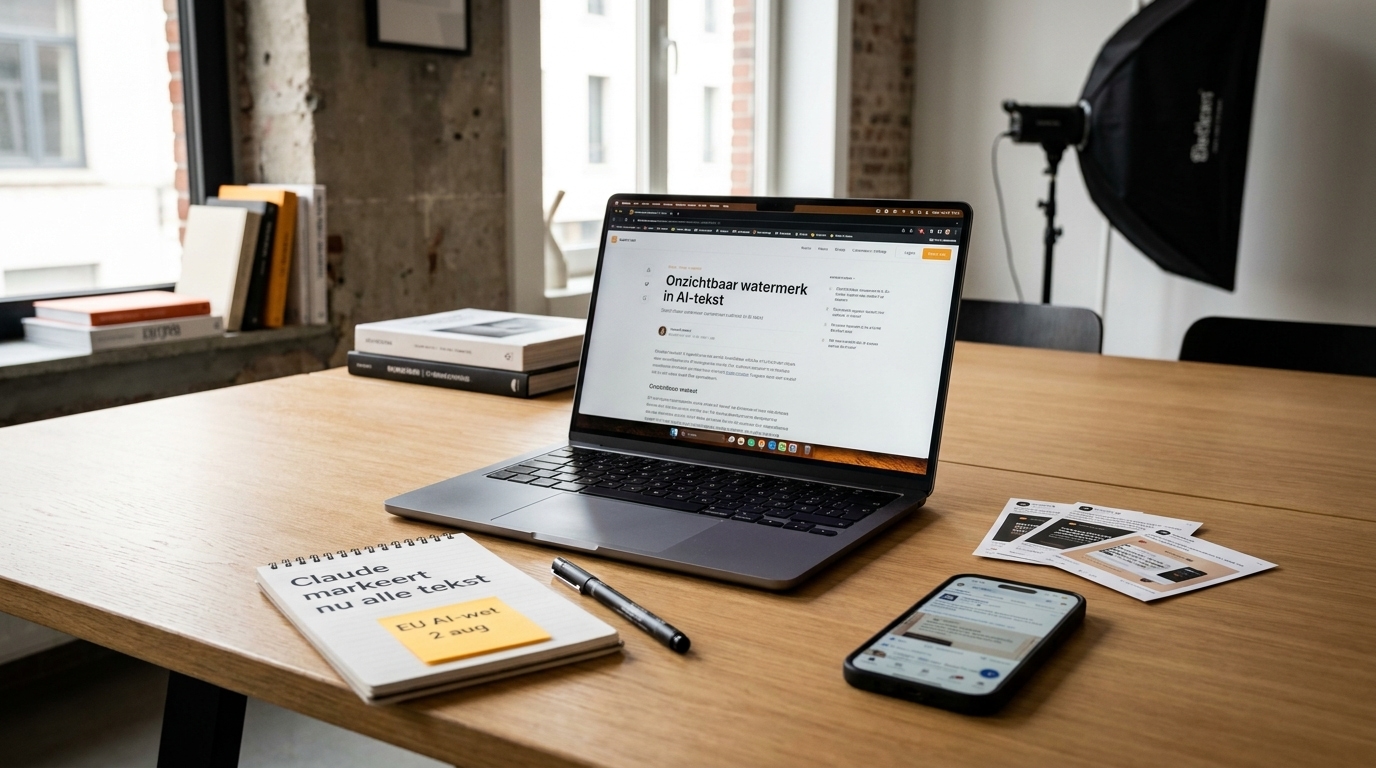
Every piece of text Claude writes now carries a mark you cannot see. Not a stamp on an image, not an “AI generated” label at the bottom of a page, but an invisible pattern woven into the words themselves.
Anthropic, the company behind Claude, announced this on August 11, 2026. It is the first major product change that flows directly from the enforcement of the EU AI Act, which kicked in on August 2. Anthropic signed the code of practice tied to Article 50(2) of that law, covering transparency for AI generated content. Signatories that fail to comply risk fines of up to 15 million euros or 3% of global turnover.
What actually changes
Text from Claude gets a statistical pattern that travels along when you copy and paste, and according to Anthropic can survive certain edits too. Files such as images get no visible watermark, but provenance metadata under the C2PA standard, the same agreement cameras and press photos already use to record origin. That metadata disappears the moment you convert a file, rework it in an unsupported tool, or simply take a screenshot. It applies worldwide, not just in Europe, and there is no way to turn it off: in the chat app, through Claude Code, in Cowork, and through Amazon, Google or Microsoft too.
A detected watermark proves Claude processed the text. Not that Claude came up with it.
That distinction is exactly where the criticism starts. People who only use Claude to proofread or translate their own writing will soon see the same mark appear as someone who had an entire article written for them. For a cover letter, a proposal, or a university assignment, that difference can matter. Google DeepMind has been doing something similar with SynthID in Gemini since 2024, and roughly 200 companies have now signed the same EU code of practice, from Meta to Microsoft.
What this means if you work with AI yourself
At The Batcave, we write part of our content, this article included, together with Claude. This news changes nothing about how we work: we rewrite, check sources and put our own voice on it, the way we share weekly on our LinkedIn page. What it does change is what “AI content” will mean tomorrow for a client or a reader. That connects to the labeling requirement that has applied to businesses since August 2, and to what we wrote earlier about why authenticity sets brands apart today. The quality of a text stays the same. What changes is that the question “is this AI?” will soon have an answer instead of a guess.
Conclusion
Visible or not, this kind of marking will show up more often in the AI tools you use over the coming months. Want to know where your brand stands today in AI answers, from ChatGPT to Claude itself? See what we can do for you.
Test whether your brand is visible to AI
As AI tools like Claude learn to mark their own content, the odds grow that customers meet your brand for the first time through an AI answer instead of Google. Our free AI findability scan checks whether your business shows up in ChatGPT, Perplexity, Claude and Gemini, reviews your schema markup and FAQ content, and delivers a report with concrete next steps. The technical groundwork takes 1 to 2 weeks, AI visibility builds over 60 to 90 days.